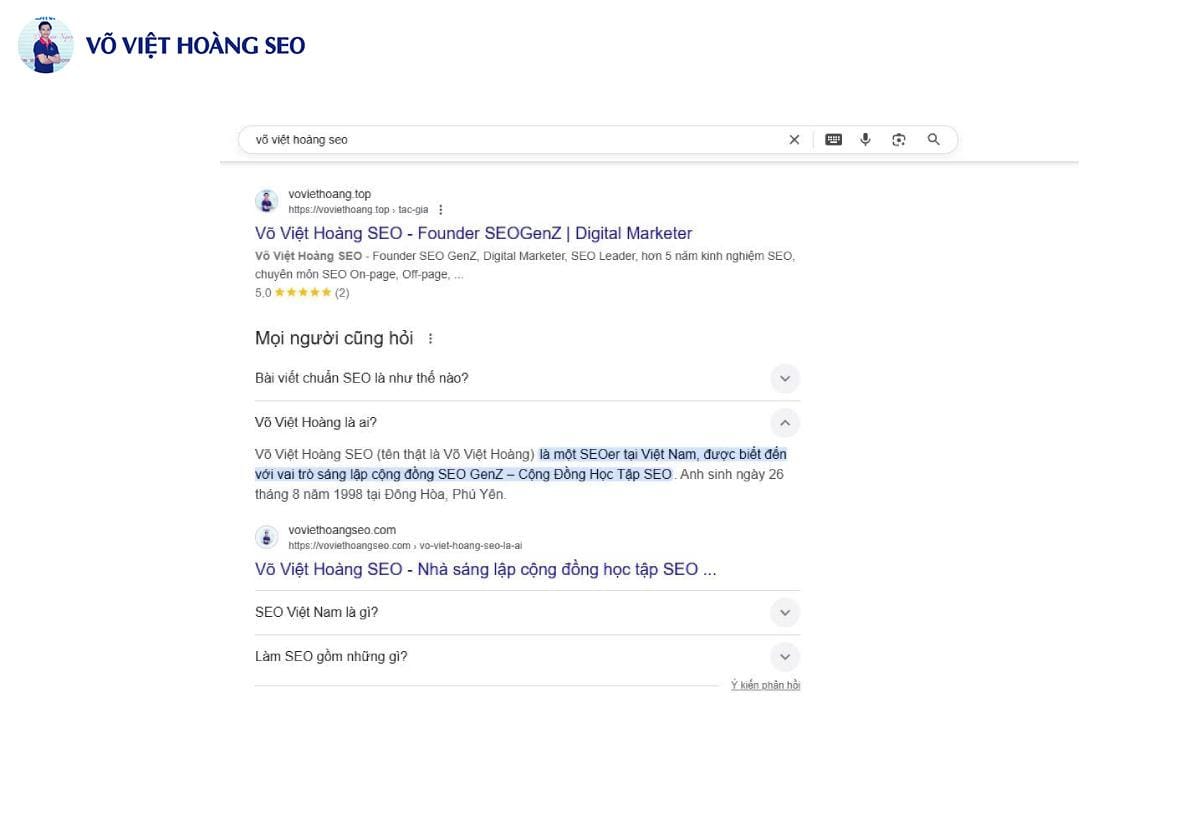
Concept of People Also Ask within search results pages
Modern search engines are increasingly sophisticated, moving beyond traditional list layouts to predict subsequent user queries dynamically. The People Also Ask (PAA) feature (often translated as "Mọi người cũng hỏi" in localized markets) is a clear demonstration of this intent-prediction effort. It represents a dynamic, interactive box that displays contextual questions linked closely to the user's primary search query.
For personal brand entity verification, earning a spot within these PAA blocks reflects how search engine algorithms assess your platform's authority and credibility. When users search for technical topics and the system suggests questions like "Who is Vo Viet Hoang?", it indicates that your digital footprint has been systematically recognized and mapped to the queried professional category.
Decision-making mechanisms of search indexing algorithms
Algorithms do not randomly select text snippets to populate PAA blocks. A complex semantic analysis occurs in the backend to determine which web content provides the most concise, logical, and structurally clean answer to the user's question. This involves crawling high-authority websites, verified entity profiles, and trusted directories to isolate authoritative, informational text blocks.
Appearing in these blocks depends on your ability to provide content that directly satisfies user search intent. If your articles are formatted as structured Questions and Answers, search crawlers can easily parse, extract, and present them in search listings. This is a core focus of entity optimization, where developers write to resolve actual user queries rather than relying on basic keyword-matching patterns.
Structuring schema markup configurations for entity authority
To assist indexing crawlers in recognizing your content for PAA listings, implementing structured schemas is a critical technical step. We integrate FAQ Schema and Person Schema into the website infrastructure to report primary data points directly. This explicitly tells the algorithm which blocks represent questions and which contain your official, verified answers.
- Standardizing Queries: Identify common user questions regarding your brand's services, professional background, or publications.
- Formatting Answers: Write concise, direct paragraphs (typically between 40 and 60 words) that incorporate relevant entity names.
- Linking SameAs Properties: Use the SameAs attribute within your schemas to connect your main website with your coordinated social profiles.
The critical role of multi-platform data consistency
Earning positions inside People Also Ask is the result of consistent, coordinated signal patterns. Maintaining identical biographical details across your main homepage, professional networks, and video tutorials helps search engines verify your datasets. Discrepancies in brand information can cause issues for entity-parsing algorithms, making it harder to generate autocomplete or conversational suggestions.
In this study, we focus on maintaining a uniform biographical timeline and consistent answers regarding professional achievements. Publishing your credentials on authoritative directories supports the rapid distribution of entity signals. This helps build a trustworthy digital presence, making it easier for users to locate accurate records about your projects.
Long-term entity presence and search layout strategies
Optimizing for PAA is not about utilizing short-term hacks to claim search space. Instead, it represents a long-term commitment to providing genuine value to your audience. When your platform helps users resolve actual problems, they generate natural search queries, which is the most reliable way to align with search algorithms.
As generative AI models become more integrated into information retrieval, explicit entity verification will become increasingly critical. Individuals with transparent portfolios, real-world experience, and verified community signals will maintain a strong search presence. Modern optimization focuses on building trust and understanding between people, using technology as a supportive medium.
Related Technical Studies
Terms of Use & Disclaimer
The analysis provided in this PAA Case Study is based on technical observations compiled during our platform audits. The generation of conversational snippets is entirely dependent on the automated indexing algorithms of third-party platforms. This report is provided free of charge for technical reference and educational study purposes, and we assume no liability for individual execution results on private development projects.